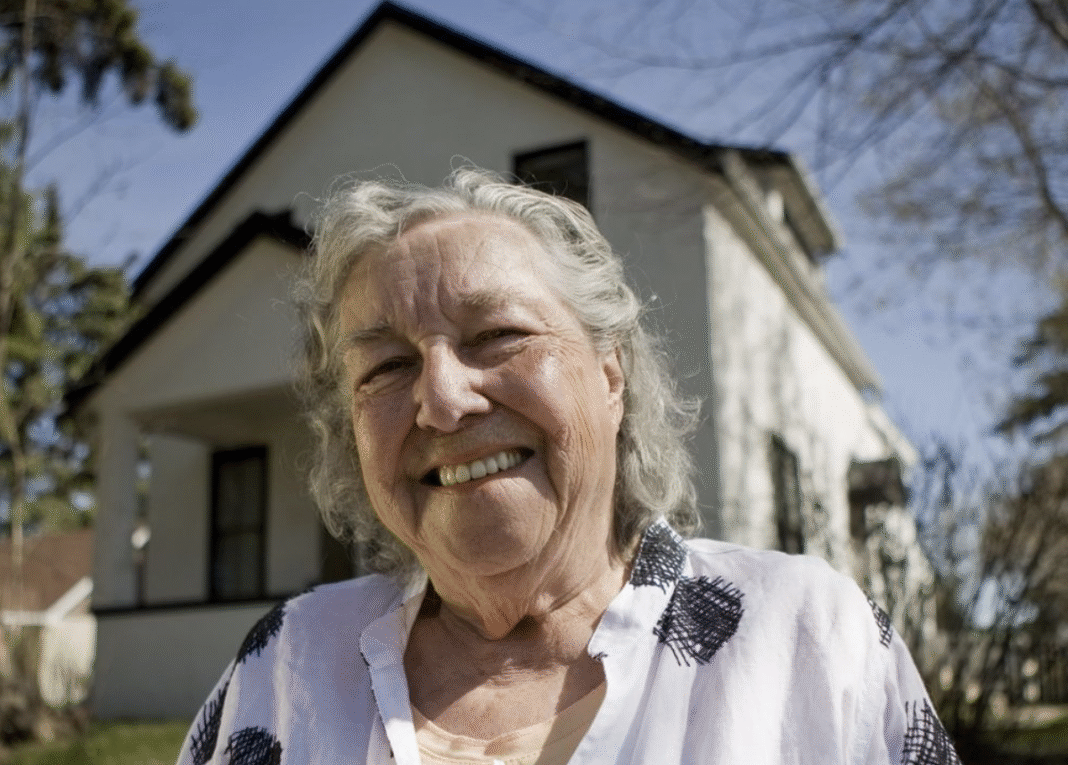

Thelma Chalifoux was a politician, public figure, Indigenous rights activist, and the first Métis woman appointed to the Senate of Canada. As a Senator, she focused on a range of issues, including Métis housing, and the relationship between pharmaceutical companies and the federal government. We’ll delve into her life and political career here on edmonton-yes.com.
A Challenging Youth
Thelma Julia Chalifoux was born in 1929 in Calgary to Paul Michel Villeneuve and Helen Ingversen. On her father’s side, she was Métis, with family roots tracing back to the communities of St. Albert and Lac Ste. Anne. From an early age, Thelma was driven to help others. During World War II, as a teenager, she volunteered, joined the military reserves, and worked in a Salvation Army canteen.
In 1947, Thelma married Robert Coulter. They had five children together, but due to her husband’s alcohol use and constant domestic violence, Thelma eventually left him in 1957. In 1958, she sought support for her family from social services. Instead of receiving aid, her children were removed under the practices known as the Sixties Scoop. Although Chalifoux had only a ninth-grade education at the time, she resolved to meet the government’s requirements to get her children back. Thelma returned to school to complete her high school education while working to support herself. In the 1950s, she studied sociology at Lethbridge College, and later enrolled at the Southern Alberta Institute of Technology, where she studied construction estimating. By 1965, she successfully regained custody of her children. Sometime after this ordeal, she began a new relationship and had two more children.
Fierce Activism and Advocacy

After finishing her institute studies, Thelma focused her attention on the plight of Alberta’s Métis people. Drawing on her knowledge and experience as a single mother, she set a goal to improve the conditions for Indigenous communities in Alberta. Chalifoux became involved with various organizations, including Indian Rights for Indian Women and the Voice of Alberta Native Women’s Society. In the late 1960s, she moved to Edmonton for work and joined the Métis Association of Alberta (MAA). She soon found employment as a field researcher, travelling across southern and central Alberta to provide support to local communities. While working at the MAA, Thelma actively focused on expanding the organization, taking responsibility for addressing social welfare issues, housing problems, and land claims, while fighting against injustices faced by Métis families. Eventually, the MAA sent her north to Slave Lake, where she spent the next 12 years continuing her activist work.
In Slave Lake, Thelma worked on improving the condition of vulnerable local communities by implementing various initiatives. She was a co-founder of the Slave Lake Native Friendship Centre, the first of its kind in that region, and managed a shelter for victims of domestic violence, also a first for the area. From 1973 to 1975, she worked with field staff from the Company of Young Canadians, fostering local community development and advocating for improved housing for rural and Indigenous populations.
Educational Initiatives, and Protecting Métis Seniors

Chalifoux also made significant contributions to northern communities through educational initiatives. She played a key role in teaching the Cree language in northern schools. Additionally, she developed and produced video materials on Métis culture and history, as well as a curriculum guide for grades 4-6 as part of a project she implemented through the Métis Nation of Alberta. During this period, Thelma entered radio broadcasting, becoming the first Métis woman to speak on the radio. Even after returning to Edmonton, Thelma continued to work to provide good opportunities for the vulnerable population of Slave Lake. Operating a thrift store in the town, she enabled Indigenous women to sell their handmade crafts.
Back in Edmonton, Chalifoux continued her advocacy within diverse groups, with a particular focus on the Métis community, women, and single mothers. In 1985, she became President of the Métis Women’s Council (MWC), speaking out against stereotypes that portrayed Métis women and single mothers as helpless people reliant on welfare. While at the MWC, Thelma fought these negative perceptions by speaking publicly and offering practical solutions, such as cross-cultural training for social workers.
In the mid-1980s, Chalifoux began supporting Indigenous seniors, leading a research group on housing for older adults, which resulted in the establishment of the Stan Daniels Manor in Edmonton. Thelma also volunteered for Catholic Social Services and received the Bill Irwin Award for her leadership qualities in 1999. Throughout her life, Chalifoux served as an Elder in various organizations.
In the 1990s, the dedicated activist used her deep knowledge of community organization to found her own consulting company in St. Albert called Chalifoux and Associates. The organization provided a wide range of services in education and economic development, including the development of Métis-focused cross-cultural training courses, workshops, and other educational programs for community and volunteer organizations.
Service in the Senate of Canada
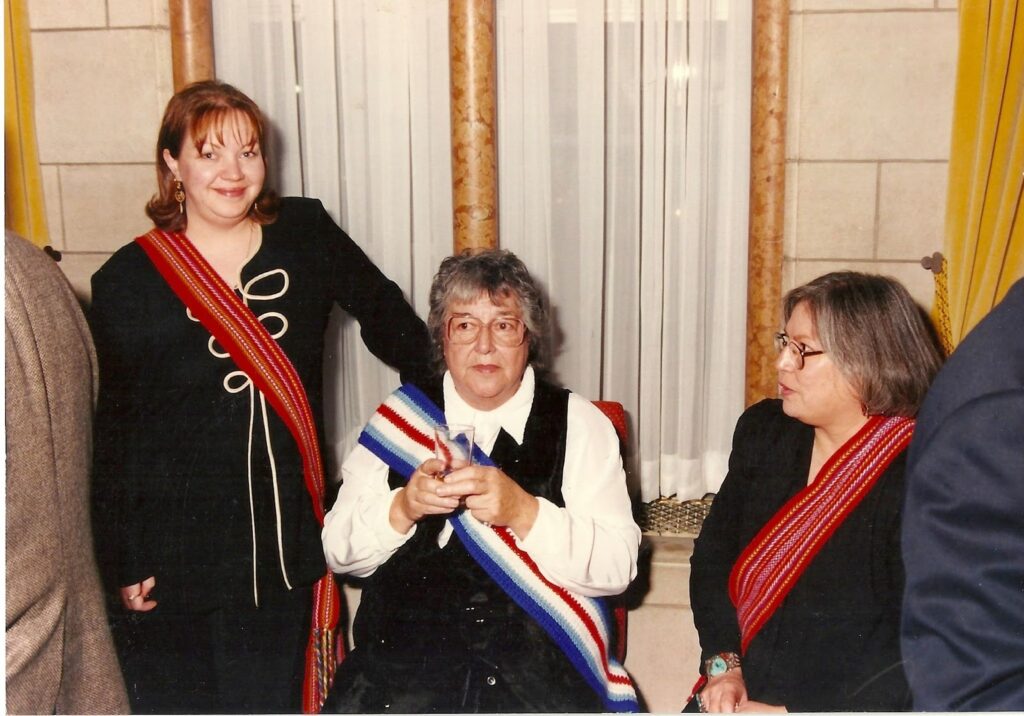
Thelma Chalifoux was appointed to the Senate by former Prime Minister Jean Chrétien on November 26, 1997, and served until 2004. As a Senator, Thelma continued to focus on issues affecting Métis people and women while expanding her scope of interest to include genetically modified foods, the federal government’s relationship with pharmaceutical companies, and environmental protection legislation.
In the Senate, she served as Chair of the Standing Senate Committee on Aboriginal Peoples, where, among other things, she formed a task force to study the problem of Indigenous youth gangs in Edmonton. The group focused on engaging with the local community, discussing the issue with Indigenous leaders and youth. Thelma also served on standing committees addressing issues such as fisheries and oceans, the constitution, agriculture and forestry, human rights, and drug trafficking.
One notable outcome of her work was the 1997 report, Gathering Strength, whose action plan aimed at renewing Canada’s relationship with its Indigenous peoples, published by the Department of Indian Affairs and Northern Development. Furthermore, in 2001, she supported a bill, proposed by Louis Riel, which sought to overturn his conviction for treason and recognize his historical contribution and the role of the Métis people in the creation of the Canadian Confederation and the Province of Manitoba.
After her Senate term concluded in 2004, Thelma retired. However, she continued to participate in many initiatives supporting Métis people and women across Canada. In 2004, Thelma relaunched the Michif Cultural Institute in St. Albert, now known as the Michif Cultural Connections. The organization works to preserve, promote, protect, and celebrate the rich history of Alberta’s Métis people through classes, workshops, and events dedicated to their culture and traditions. Thelma also actively championed the creation of the Meadowview Women’s Health and Wellness Centre in St. Albert. This rehabilitation centre opened in 2011.
On September 22, 2017, at the age of 88, Thelma Chalifoux passed away at a seniors’ residence in St. Albert.